First: Strong Data Analytics Foundations
First, they must give you strong data analytics foundations. That way you can actually review and challenge AI generated outputs, and use AI as a multiplier rather than a way to build black box solutions that nobody understands.
Second: Think About the Business
Second, they must teach you to think about the business, to understand the business problems and goals, and to think like a business owner, so you’re not just creating reports for the sake of reporting.
Third: Use AI Effectively
Third, you need to learn how to use AI effectively to build data analysis workflows and systems that let AI do the leg work, such as cleaning and preparing the data. That frees up more of your time for what really matters, solving business problems.
My Top Five List
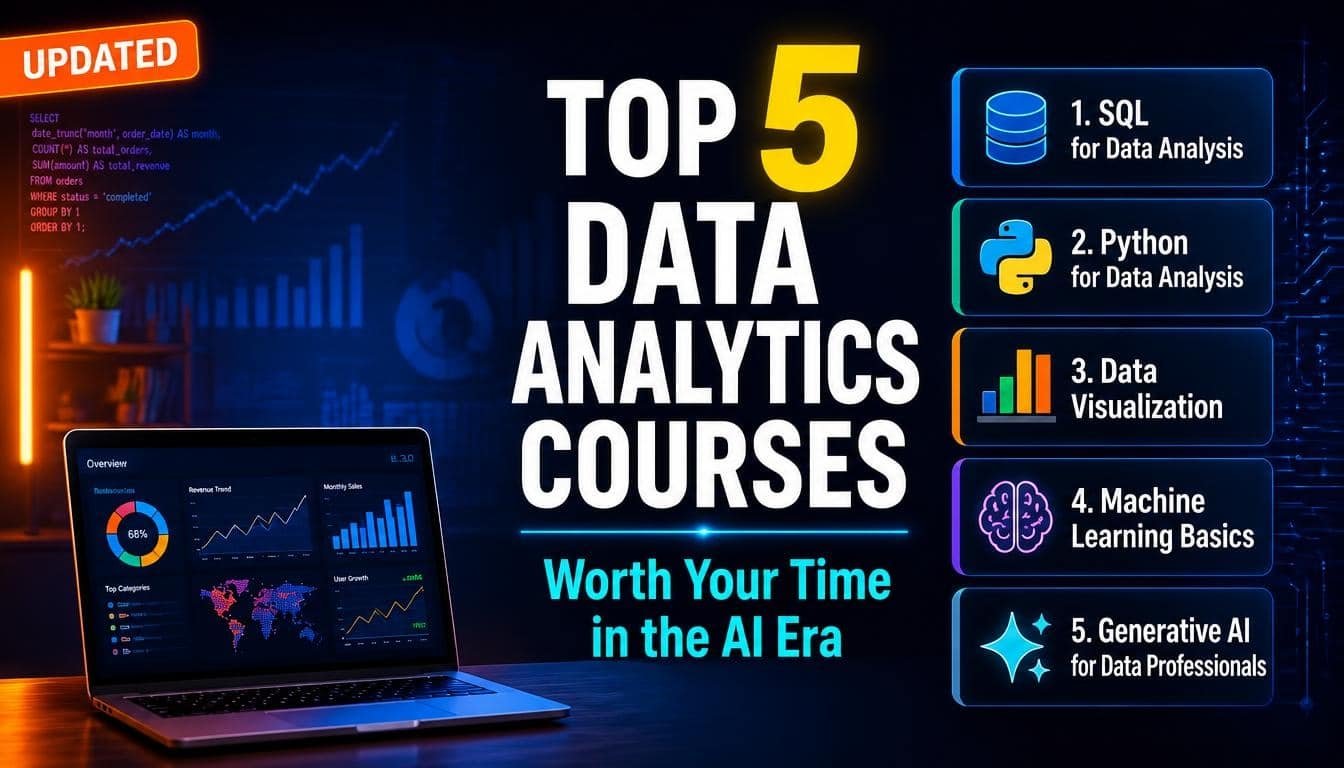
Here’s my top five list right now. This is just my list. You can completely agree or disagree.
Associate Data Analyst in SQL from DataCamp
Why SQL Matters
If you’re serious about becoming a data analyst or any sort of analyst, then you need to get good at SQL. AI writes SQL, and it writes it with total confidence, even when the join is wrong and your revenue just quietly doubled. If you can’t read the query, you can’t spot when something is wrong. So SQL didn’t get less important because of AI. AI can help you write code faster, but only if you actually know what your query is doing.
The Associate Data Analyst in SQL Track
The best course, or in this case a whole learning track, I know for building your SQL skills is the Associate Data Analyst in SQL track on DataCamp. You log in through your browser and start writing queries from day one, even if you have never written a query in your life. DataCamp and I have partnered up to make this video, but if you’ve been watching this channel for a while, you know it has been one of my go-to platforms for leveling up my own data skills for years now. This track is very solid. It takes you from your first select statement through joins, subqueries, and window functions, and you work on real business problems along the way, not just syntax drills.
The Certification
The track is also set up to prepare you for DataCamp’s certification. That’s an exam you actually have to pass, not a badge for watching videos, which in my view says a lot more to a recruiter or a hiring manager nowadays. In this day and age where anyone can build anything pretty quickly, a certification where you actually have to pass an exam might be the difference maker in getting into the next round of a job application.
Google Data Analytics Professional Certificate on Coursera
One of the Most Popular Courses
Next up is one of the most popular courses out there, the Google Data Analytics Professional Certificate. It’s designed by Google, which matters because you don’t want to do a course and get a certificate from a company nobody’s heard of. At the time of making this video, there were about 4 million students enrolled, which I think is crazy. To do some gut check data analysis, this number tells me two things. One, the demand for this course is high. Two, it’s more of a starting point in your data journey, not the finish line.
The Course Has Changed
The course itself has changed a lot since last year. It now has nine courses, and the major additions are all around bringing AI into your data analysis workflow, such as using AI to clean data, write formulas, and build charts. There’s even a bonus at the end on using AI in your job search.
My Honest Take on the AI Part
Here’s my honest take on the AI part. It’s useful, but it’s not the reason to take this course. Take it for the foundations: asking the right question at the start, cleaning data properly, and presenting what you found in a way people actually understand. Those are the parts AI cannot do for you, because AI doesn’t know what your manager actually asked for.
Step One in Your Data Journey
If you finish this course and get the certificate, please don’t expect the job offers to just roll in. That’s not how any of this works. Recruiters and hiring managers won’t be knocking on your door every 3 seconds just because you finished a beginner level course. If you have zero experience, this course is useful. Just treat it as step one in your data journey.
Data Analyst in Python from DataCamp
Why Learn Python
This one is for those of you with coding ambitions: the Data Analyst in Python track from DataCamp. I won’t lie, learning Python is hard even with AI. It’s much harder than writing SQL queries. AI can write Python code for me, so why bother learning Python? The simple answer is you cannot review, challenge, and correct something you don’t actually know how to do yourself. AI can write the code for you really quickly nowadays, which gives you a baseline. Your baseline, however, is not your target. Your target is code that is optimized and accurate for your business, not some generic business.
Where AI Goes Wrong
AI can put a filter in the wrong place, or calculate an average where what you needed was actually the median. Everything will run smoothly and look good, but it won’t reflect the code you actually wanted to write.
The Goal Has Changed
The goal has changed. You don’t need to write every line from scratch from memory anymore. In fact, you probably shouldn’t. But you do need to be able to read it, question it, and fix it.
What the Track Covers
The Data Analyst in Python track from DataCamp, with its 15 courses and many bonus projects, will give you the confidence to write, review, and challenge whatever Python code you have. It covers the main data analysis libraries such as pandas, numpy, seaborn, and matplotlib, plus hypothesis testing, sampling, and combining multiple data sets.
The Projects
The projects are hands-on, practical, and very relatable. You’ll investigate Los Angeles crime rates, analyze Netflix movie data, and explore New York City public school test results, among many other things. Just like with most DataCamp courses, the tools and data sets are already built into the platform and you can access them directly within your browser. So you spend your time on the interactive exercises and the projects, not on installing things and fixing your setup.
Thinking Like an Analyst from Maven Analytics
A New Course on the List
This is a new course on the list. It is short, but in my opinion it is really good. Thinking Like an Analyst from Maven Analytics is about 3 hours of content that takes you from not knowing what to do with a vague business request to knowing how to break it down into smaller measurable drivers that move the business goal the request is connected to. Most data courses teach you the tools. This one teaches you how to think before you even touch a tool.
Why This Matters More Now
Here’s why this matters more now than it did a year ago, or two or three years ago. When technical execution gets cheap, the analyst who adds the most value is the one who knows which number actually matters to the business. Think about which KPI moves the decision, which KRI to look out for, and what the recommendation should be, not just what the chart shows. That’s the ability to understand the business, your business, and AI cannot solve that for you.
Agentic Analytics from Mo Chen on LinkedIn Learning
The AI Angle
Last, but certainly not least, the AI angle. Full disclosure, this is my own course on LinkedIn Learning. I created it because many of the AI courses I saw were teaching you how to write better prompts, but not how to create repeatable workflows. In this course, you learn how to go from prompts to running a data analysis system. We work inside Claude Cowork and build three skills. A skill is just a saved process Claude follows every single time.
First Skill: Problem Framer
The first one, the problem framer, turns a vague business request into a clear analytical brief before anyone touches the data.
Second Skill: Data Analyst
The second, the data analyst, runs the analysis and checks its own numbers before it reports anything.
Third Skill: Stakeholder Communicator
The third, the stakeholder communicator, turns those findings into a message for the specific person who asked.
The Plug-in
Then we package all three into one plug-in that runs them in order. The last chapter is my favorite part. We point the finished plug-in at a completely different data set from a completely different industry and see that it still works.
Why This Order
I structured the skills in this order because problem framing should always come first. If you don’t have a clear problem to solve, broken down into an analytical requirement, then what is the point?
Intermediate to Advanced
This is an intermediate to advanced course, I’d say. So I would not take this one if you’re just starting out.
What Courses You Should or Should Not Pick
These are my top five data analytics courses as of today. Pick whichever one you think suits you best right now. That may be one, all, or none of the courses I mentioned, since you might want to build data analysis skills that I did not cover.
Please Remember This
AI is democratizing technical skills, which means domain knowledge, asking the right questions, understanding which business problems to actually solve, and owning the recommendation and the decision are becoming increasingly valuable. The softer, more critical thinking type of skills matter more than ever.