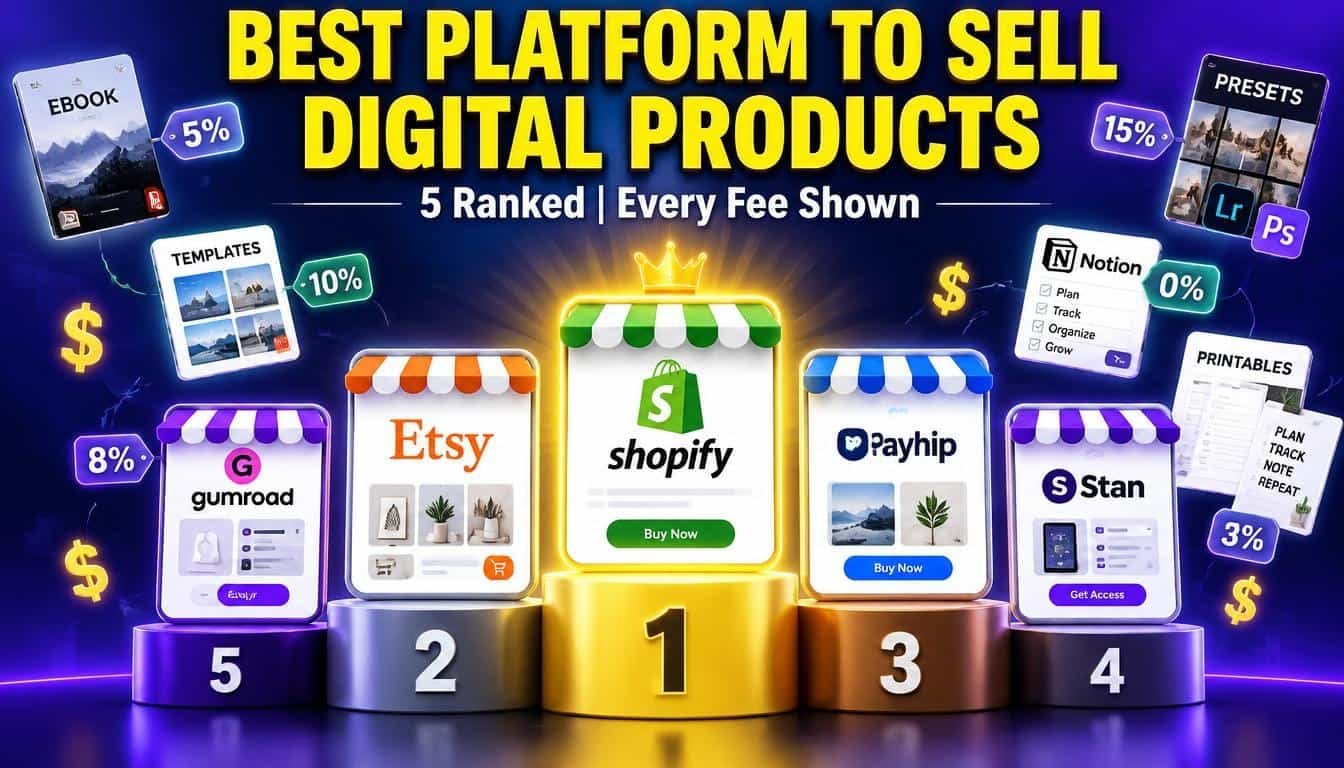
Five Platforms Ranked
I’ve sold over half a million dollars in digital products, and I got frustrated with the platforms. In this article we’re going to look at five platforms and rank them with every fee on the screen. For each one, I’ll tell you exactly who should pick it. The goal is that by the end, you know precisely where your products belong.
Where I Stand
I co-founded one of the tools covered here. I’ll share which one when we get there, but my co-founder and I built it because of the exact frustrations we saw with most tools out there.
Disclosure: This article may contain affiliate links, which means we may earn a commission if you sign up through them, at no extra cost to you.
Three Things Any Platform Has to Have
There are three things any platform covered here has to have, and this is how all five are scored.
Merchant of Record
The first is that they need to be a merchant of record. It’s also known as an MOR, and what that means is whether they handle global sales tax and compliance, or whether you have to become your own tax department.
The Selling Layer
Two is the selling layer: the checkout, the delivery, and a storefront that buyers are going to trust.
Growth Tools
Three is growth tools, like affiliates, cart recovery, and upsells, that take all of this from “how do I sell?” to “how do I sell more?” And on top of all that, is it beautiful?
Number Five: Sellfy
Sellfy comes in at number five. You only pick this if you have digital products and physical products that you want to sell together. You could honestly do this on Squarespace as well, but let’s stay focused. Sellfy offers print on demand and digital downloads in one store, and nothing else on the list does that. It also offers discount codes, email marketing, tracking pixels, affiliate marketing, upsells, and cart abandonment emails, so it has a good set of growth tools.
Pricing
Sellfy runs its subscriptions at $29, $79, or $159 a month with no transaction fees. It is important to pay attention to the fine print, though. The $29 plan caps you at $10,000 a year in sales. So even if you don’t need more features, if you’re selling more than $10,000 a year, you’re going to need to upgrade. And on the three things we just discussed, Sellfy is not a merchant of record. That means you’re going to need to figure out some tax information in the countries you’re selling in, which gets complicated fast. Sellfy is best for steady sellers who want flat pricing and physical merch in the same cart. For everyone else, let’s keep going down the list.
Number Four: Stan Store
Next up is Stan Store. Stan is really cool because it bundles a lot of things that other tools don’t offer, like coaching call bookings, a course builder, communities, and even Instagram DM automations. That bundle sounds great, but it will cost you $29 a month before your first sale. And when it comes to the actual growth tools, the email flows, the upsells, and affiliates, those live on the $99 a month plan. That comes out to about $1,200 a year, and there’s no transaction fee. You still need to pay processing fees, which is the standard 2.9% plus 30 cents per transaction.
The Short Version
The short version is you’re going to want a consistent four figures a month before the pricing really starts to make sense. If you sell $500 a month and pay $100 of it for the platform, that isn’t going to add up well. Stan Store is probably best for creators who are selling calls, communities, and DM driven offers. If that is your business, especially if you want the community, courses, and calls built into the same place you house your digital products, Stan Store is a great way to go.
Stan Store is going to help you sell your time if you’re building a community or selling calls. But if you are really here to sell digital products, let’s move on to number three.
Number Three: Payhip
Payhip is the closest thing to the classic digital downloads experience, and it’s cheap. The free plan takes 5% of every sale and includes every feature they offer. It looks like PayPal from 2010, but it’s also free. If you go to the paid plan, it starts at $29 a month, and that drops the transaction fee from 5% to 2%. And let’s be clear, that 5% is their fee. You’re still going to pay a payment processing fee as well. So on the free plan, you’re paying 5% plus the standard 2.9% and 30 cents per transaction. Then if you go to $99 a month, there is zero transaction fee.
A Few Catches
As you can tell, there are a few catches. First, payments run through your own Stripe or PayPal account, so processing stacks on top of those numbers and you’re not getting the full merchant of record protection. And the storefront feels dated, so if design is a big part of your brand, you are going to hit a ceiling quick. It feels like going back in time. Still, Payhip is best for budget-first beginners who want something simple and familiar and don’t mind managing their own payment stack. That leads us to number two, and honestly, I don’t want to include it on the list, but I’ll share a little more on why in a moment.
Number Two: Lemon Squeezy
You may have heard of Lemon Squeezy. On our three qualifiers it hits all three, kind of. It is a full merchant of record, it has a few growth tools, and the checkout is okay. The checkout experience is better than some of the other products we talked about, but it’s definitely not the best. And here’s the catch. Stripe purchased them about a year and a half ago. If you’re the owner of the company, that’s awesome. For users, though, the product has felt stagnant. The owners themselves published an article about how their focus shifted, after the acquisition, from building Lemon Squeezy to building Stripe’s own version of it. What that means for you is that, in my experience, the product has stagnated.
Pricing
Pricing works a little differently than the other tools we’ve looked at. It’s 5% plus 50 cents all in, which includes the transaction fee, and there’s no monthly fee. They do charge a bit more for some of their marketing tools. So for anyone selling digital products today, you are getting a tool that feels dated and, by many accounts, has poor support. Take a look at their Trustpilot reviews, where by my count 88% are one star. The website looks beautiful and the promise is big, but in my view they don’t deliver the way they used to, especially since the Stripe purchase. It is also very difficult to get your store approved, and plenty of people have dealt with headaches there.
Why It Barely Made the List
That’s why Lemon Squeezy arguably shouldn’t even be on the list, but I included it to make sure that if you were checking it out, you were fully aware. And by the way, Gumroad isn’t on the list because, as far as I can tell, it hasn’t had a meaningful update in about seven years, and its fees are crazy. That’s a conversation for another time. All of this leads us to number one, and number one today is Blink.
Number One: Blink
This is the one that I co-founded, but let me show you why I think it earns this spot. Let’s take a look at our three pillars. Blink is a merchant of record in over 130 countries, which means taxes, refunds, and chargebacks are handled. For the selling layer, you get customizable storefronts and checkouts built to convert. You also get embedded and overlay checkouts that you can use on your own site so people never have to leave it, plus checkout links that you can paste in a bio or a DM. There’s also one-click import of your products from other tools like Lemon Squeezy, Gumroad, Polar, and more. And you can set all of this up, build your store, and launch it before you pay a thing.
Growth Tools
Then there are the growth tools: order bumps, cart recovery, affiliate programs, email broadcasts, geo-pricing, and revenue splits. What’s the catch? I don’t think there is one. Things are broken down simply.
Pricing
Pricing is $0 a month. We don’t make any money until you do, which is why it’s built to help you grow. You pay 5%, which covers the transaction fee, plus 50 cents per transaction. Again, no sales, no fees. So if you are selling any of the top 10 digital products right now, whether it’s resume templates, printables, CapCut packs, Notion systems, presets, Framer templates, or something similar, every one of those is a digital deliverable, which means you could sell every one of them on Blink.
Most Beautiful Storefront
In my opinion, as well as the hundreds of people who have signed up, Blink is the most beautiful storefront. We may be new to the game, but we are shipping new features constantly, and the early wave of adopters are loving it.
The Best Platform to Sell Digital Products Today
In my view, the best platform to sell digital products today is Blink. You keep more of your money, there’s no monthly fee, and the setup takes minutes. If you’re selling merch next to your downloads, Sellfy is the better fit. If you’re selling your time and a community from a link in bio, check out Stan Store. If you want the cheapest place to sell your digital products with your own Stripe account, check out Payhip. And if you’re selling software licenses, Lemon Squeezy may be the right option, just be mindful of the add-ons and the delayed support. But for most creators asking where to sell their digital products in 2026 and 2027 and beyond, whether it’s templates, printables, presets, or Notion systems, in my humble opinion, it’s going to be Blink.
One More Note
Marketplaces like Etsy and Gumroad’s Discover could make sense as a second channel. They could bring you traffic, but they also charge a hefty fee. If you want to claim your handle today, go to blink.store.