Disclosure: This article may contain affiliate links, which means I may earn a commission if you sign up or buy through them, at no extra cost to you.
The importance of diversification
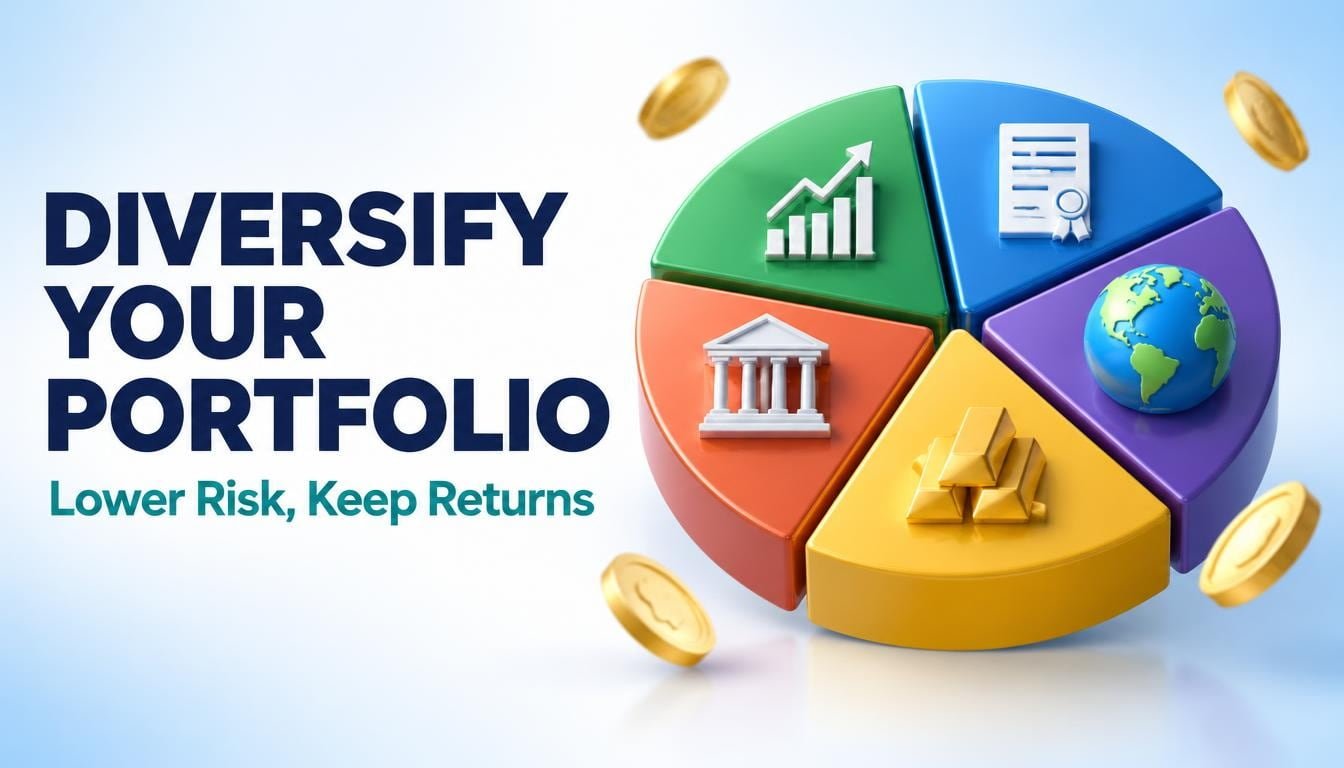
I often see, whether it’s on YouTube, Instagram or TikTok, people sharing what’s inside their portfolios or, if they’re a fin influencer, telling their audience to just buy this stock or this ETF if you want to get rich. What I almost never see them talk about is the importance of diversification, and that is what we’re going to discuss in this video: how to make sure your investment portfolio is properly insured so you can mitigate risk without necessarily having to sacrifice returns.
BMO ETFs has a ton of educational content about ETFs, some of which we will be exploring in this video, that you can find on their website, ETF Market Insights, or their ETF Market Insights YouTube channel. I’m actually featured as a host in some of their YouTube videos too.
What does diversification mean?
Ultimately it means don’t put all of your eggs in one basket, but instead put them in lots of different baskets. The saying actually originates from Miguel de Cervantes‘ novel Don Quixote from 1605. The quote is “It is the part of a wise man to keep himself today for tomorrow and not venture all his eggs in one basket,” which simply means don’t risk everything on one single thing, diversify.
What this actually means for an investor is to make sure that you are investing in different asset classes that have negative correlations to each other, as well as different sectors, industries and regions. By doing this you’re going to limit your exposure to risk while also lowering the level of volatility in your portfolio. Read More
The biggest mistake I see investors make
One thing I see a lot of people do, especially influencers based in the US, is tell their audience to just buy a simple S&P 500 index fund and call it a day. As a pretty vocal index investor myself, you may be wondering why I don’t think this is a good idea. First and foremost, I don’t think there’s anything wrong with investing in a fund like this, like BMO’s S&P 500 Index ETF (ZSP) for example, but perhaps consider it as just a part of your portfolio.
If this was the only fund in your portfolio, then you would only be getting exposure to the largest 500 companies in the US. What about Canadian companies? You wouldn’t get any exposure to them. What about companies in international and emerging markets? You wouldn’t be investing in any of them either. Not only that, because the S&P 500 only covers about 80% of the US equity market, you’re not getting any exposure to some smaller companies that didn’t make the index but may have solid growth potential.
The S&P 500 has done really well in the past few years
One argument could be that the S&P 500 has done really well in the past few years. For example, BMO’s S&P 500 Index ETF (ZSP) had a total return of 23.08% as of December 29th, 2023, so if you had invested $110,000 in ZSP on January 3rd, 2023, by December 29th of that year you’d have $1,244 in your portfolio, a profit of just over $2,200 for literally just letting that fund do its thing.
The importance of looking at long-term historical returns
But looking at one-year returns doesn’t really show you anything except what happened last year. If you want to get a true sense of what to expect from an index, and thus an index fund, you have to look at a much longer period of time. For example, here are all the total returns of the S&P 500 since its inception in 1926. As you can see, although there have been many years with double digit positive returns, there have also been many years with double digit negative returns or very low returns. Just looking at this, there is a ton of volatility going on.
How would you feel if it was the year 2000 and you put all of your money into an S&P 500 index fund and had to experience three years of negative returns? I’d bet you would wish you hadn’t put all of your eggs in that basket and had instead invested in some other baskets to safeguard your money.
Negative correlations
Earlier I mentioned a term that you may not be super familiar with, which is negative correlation. This is essential for a diversified portfolio because it means you’re investing in things that tend to move in opposite directions. If two assets have a positive correlation, that means they would move parallel to each other. For example, if you invest in 10 different tech stocks, they would have a positive correlation to each other, so you wouldn’t be that diversified.
Hobbies
It’s like saying you have a ton of different hobbies, and then it turns out all of them are related to sports: playing sports, watching sports, coaching sports, sports betting. Although those hobbies are slightly different from one another, just like those tech companies are slightly different from each other, at the end of the day all of those hobbies are about sports. It may be a good idea to broaden your horizons, diversify a little bit more and take up drawing or join a book club.
Tech stocks and utility companies
Going back to tech stocks. What you would want to do is also invest in an industry that is typically negatively correlated to tech. Like utility companies. Historically, tech companies have done really well during periods of economic expansion. But they were typically abandoned during economic downturns in favor of more defensive and stable stocks like utility companies. So if you invested in both, when those tech stocks hit a trough. You would see a rise in your utility stocks. And when those tech stocks are on the rise you would see some slower growth in those utility stocks. Although you would experience slightly lower highs than. If you were to go all in on tech when it was on the rise. You’d also safeguard yourself from those really low lows when it’s on the decline.
Stocks and bonds
Going beyond industries, this is why most investors don’t just invest in stocks. They also invest in bonds, because the two have often moved in opposite directions. When things are going well in the economy, people rush to stocks. And when the economy is unstable or on the downturn, people rush to bonds. If you invest in both, you’ll be prepared for either situation.
How to make a diversified portfolio
Now that you understand the general concept of diversification, you may be wondering how to build a diversified portfolio. One easy way is to simply invest in a fund that is already well diversified, like an asset allocation ETF. I’ve already made an in-depth video all about asset allocation ETFs. But let me show you what it would look like if you invested in one.
The BMO Growth ETF (ZGRO)
Let’s take a look at the BMO Growth ETF (ZGRO). As you can see, it is diversified. It’s a mix of 80% stocks and 20% bonds. So you’ve got that negative correlation with these two different asset classes, and then there’s a lot of diversification within those asset classes too. For the stocks portion, it’s invested in companies from Canada, the US, international and emerging markets. As you can also see, the US component isn’t just invested in the top 500 companies in the US but also mid cap and small cap companies. Giving you much broader exposure to the US equity market compared to just investing in an S&P 500 index fund.
And since this asset allocation ETF is essentially a fund of index funds. It’s investing in the broad market for each of these regions. So you don’t have to worry that it’s only invested in tech stocks. It’s invested in companies in a variety of industries that are not all moving in the same direction.
The bonds portion
The bonds portion is also very well diversified. As you can see, it’s invested in Canadian and US bonds. And within those regions it holds government and corporate bonds. Short-term and long-term bonds from 1 to 30 years in maturity. And bonds with different credit ratings, from AAA, which are bonds with the highest credit rating, to BBB. Which are bonds with a medium credit rating but typically have a higher yield.
Performance
In terms of its performance, if you had invested $10,000 when it launched on January 13th, 2019. Then after 5 and a half years, as of June 30th, 2024. It would have grown to $16,669.24, or an overall return of 59.2%. Again, not bad for simply buying a diversified asset allocation ETF and letting it grow on its own.
Building your own portfolio
If you don’t want to invest in an asset allocation ETF because you’re a die-hard DIY investor and like having the freedom and flexibility to choose your own ETFs, you can of course build your own portfolio with whatever ETFs you like. Or if you just want to model a portfolio that already exists, because who wants to reinvent the wheel, you can literally copy the composition of an asset allocation ETF, buy your own ETFs, and then manage and rebalance it on your own. If you’d like to learn more about how to actually do that, I’ve got a video all about it.
Continue learning about ETFs
At the end of the day, spreading your money across different baskets is what keeps one bad year or one bad sector from sinking the whole portfolio. To keep learning about ETFs, check out the educational resources on the ETF Market Insights website and the ETF Market Insights YouTube channel. There’s a lot of great content on there.